
Monday, November 25, 2013
Congressional Reception

Tuesday, November 12, 2013
SCHENECTADY COUNTY : Sun panels to brighten district’s ledgers
School solar plan to save nearly $1M over 20 years
School solar plan to save nearly $1M over 20 years
Scotia-Glenville schools are set to save nearly $1 million over the next two decades after a recent decision by the school board to install solar panels on the district’s six buildings and bus garage.
The district will be the fi rst in Schenectady County to make the move to solar and soon will be one of a handful in the Capital Region to harness the power of the sun. The Board of Education approved a proposal Oct. 21 to install solar
panels from Monolith Solar, a Rensselaer company.
‘A LOT OF ROOF SPACE’
“We have a lot of roof space in the school district,” said Superintendent Susan Swartz in a news release. “Why not cover them with something that will save our taxpayers money? We are doing this because it makes a lot of sense, from a fi scal and environmental point of view.”
Monolith Solar will own and operate the panels. The school district will lease them and purchase any and all solar energy the panels produce as a result. School offi cials estimate the move will save about $43,000 in electricity costs each year and nearly $920,000 over the next 20 years.
The most savings will come at the high school, where the district hopes to install panels above the auditorium and the new gymnasium. This would produce 207,747 kilowatt hours of energy in the first year, offsetting about $5,684 in utility costs that year and $147,080 over the next two decades. MONITORING THE SAVINGS
Each panel will come with a meter the district can monitor online. A National Grid conversion system will allow the utility company to measure how much energy is being produced by the solar panels and how much is being provided by the power grid.
At the middle school on Prestige Parkway, panels would be installed above the auditorium, gymnasium and second-floor classrooms near the library. These would produce 206,764 kilowatt hours of energy in the first year, offsetting about $5,657 in utility costs that year and $146,384 over 20 years.
Each of the district’s four elementary schools would get panels, too. Glendaal Elementary School would get panels above the gym, lobby and primary wing. They would produce 196,185 kilowatt hours of energy in the fi rst year, offsetting about $5,368 the fi rst year and $138,894 over time.
Glen-Worden Elementary School would get panels above the gym, main offi ce, cafeteria, lobby and primary wing to produce an annual 186,387 kilowatt hours of energy. In the fi rst year, this would save $4,701. Over 20 years, it would save $121,649.
At Lincoln Elementary School, panels would be installed above the gym, cafeteria hallways, main office, library, primary and secondary wings. They would produce 156,856 kilowatt hours of energy in the first year, saving the district an estimated $4,291 in utility costs in the fi rst year and an eventual $111,050.
Sacandaga Elementary School would get panels above its gym, cafeteria, hallways, the wing facing Wren Street and classrooms in the kindergarten wing. They would produce 206,570 kilowatt hours of energy in the fi rst year, saving about $5,652 that year and an eventual $146,247 over 20 years.
The bus garage is also set to get panels across its entire roof. They would produce 49,738 kilowatt hours of energy in the fi rst year, offsetting about $1,361 in utility costs that year and an eventual $35,213 over 20 years.
Monolith Solar will also seek grant funding from the New York State Energy Research and Development Authority to pay for part of the installation. The state sets aside about $4.8 million per month to encourage such solar installations and has an open enrollment program that provides funding for both residential and nonresidential systems.
The district will be the fi rst in Schenectady County to make the move to solar and soon will be one of a handful in the Capital Region to harness the power of the sun. The Board of Education approved a proposal Oct. 21 to install solar
panels from Monolith Solar, a Rensselaer company.
‘A LOT OF ROOF SPACE’
“We have a lot of roof space in the school district,” said Superintendent Susan Swartz in a news release. “Why not cover them with something that will save our taxpayers money? We are doing this because it makes a lot of sense, from a fi scal and environmental point of view.”
Monolith Solar will own and operate the panels. The school district will lease them and purchase any and all solar energy the panels produce as a result. School offi cials estimate the move will save about $43,000 in electricity costs each year and nearly $920,000 over the next 20 years.
The most savings will come at the high school, where the district hopes to install panels above the auditorium and the new gymnasium. This would produce 207,747 kilowatt hours of energy in the first year, offsetting about $5,684 in utility costs that year and $147,080 over the next two decades. MONITORING THE SAVINGS
Each panel will come with a meter the district can monitor online. A National Grid conversion system will allow the utility company to measure how much energy is being produced by the solar panels and how much is being provided by the power grid.
At the middle school on Prestige Parkway, panels would be installed above the auditorium, gymnasium and second-floor classrooms near the library. These would produce 206,764 kilowatt hours of energy in the first year, offsetting about $5,657 in utility costs that year and $146,384 over 20 years.
Each of the district’s four elementary schools would get panels, too. Glendaal Elementary School would get panels above the gym, lobby and primary wing. They would produce 196,185 kilowatt hours of energy in the fi rst year, offsetting about $5,368 the fi rst year and $138,894 over time.
Glen-Worden Elementary School would get panels above the gym, main offi ce, cafeteria, lobby and primary wing to produce an annual 186,387 kilowatt hours of energy. In the fi rst year, this would save $4,701. Over 20 years, it would save $121,649.
At Lincoln Elementary School, panels would be installed above the gym, cafeteria hallways, main office, library, primary and secondary wings. They would produce 156,856 kilowatt hours of energy in the first year, saving the district an estimated $4,291 in utility costs in the fi rst year and an eventual $111,050.
Sacandaga Elementary School would get panels above its gym, cafeteria, hallways, the wing facing Wren Street and classrooms in the kindergarten wing. They would produce 206,570 kilowatt hours of energy in the fi rst year, saving about $5,652 that year and an eventual $146,247 over 20 years.
The bus garage is also set to get panels across its entire roof. They would produce 49,738 kilowatt hours of energy in the fi rst year, offsetting about $1,361 in utility costs that year and an eventual $35,213 over 20 years.
Monolith Solar will also seek grant funding from the New York State Energy Research and Development Authority to pay for part of the installation. The state sets aside about $4.8 million per month to encourage such solar installations and has an open enrollment program that provides funding for both residential and nonresidential systems.
Wednesday, November 6, 2013
5 Reasons Solar Is Already Beating Fossil Fuels
Posted: 11/05/2013 2:35 pm
Follow

It's frustrating to still hear dissenters say that renewable energy is not ready to compete with fossil fuels as a means to power our country. The solar industry is growing dramatically every year, while fossil fuels continue to be phased out. Solar is no longer the cottage industry it was decades ago. Stunning advancements in production and financing have brought solar to the playing field with coal, oil, natural gas, and nuclear. And here are five reasons why solar is already winning.
1. Jobs

There are more people in the U.S. employed to create solar energy than to mine coal. The banal argument that transitioning to a clean energy economy will cost us jobs is false. Solar is growing over 10 times faster than the American economy.
In 2012, solar added 14,000 new jobs, up 36 percent from 2010 and the industry will add another 20,000 jobs this year. The fossil fuels industry cut 4,000 jobs last year. During their recent solar boom, Germany doubled their solar workforce to over 400,000. The most important point is that renewables are more job-dense than fossil fuels, so even at the same price, solar will employ more people than fossil fuels. When it comes to employing Americans, solar is winning.
2. Price
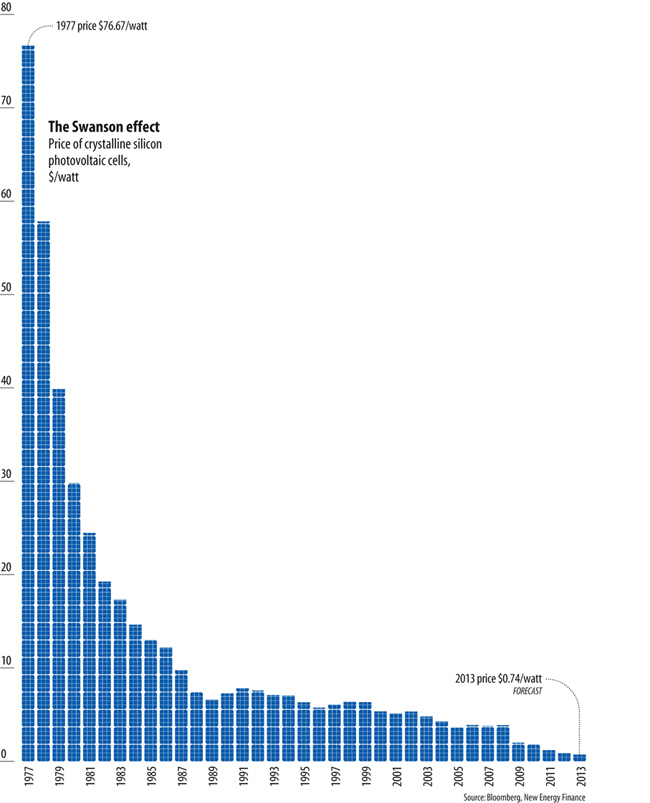
Solar panels have a seen a consistent drop in prices over the last three decades, and in the last few years that drop has been meteoric. In the last 35 years prices have gone from $77/ watt to around $.75/ watt. That makes solar 99 percent cheaper than it used to be. Since 2008, the cost of coal has risen 13 percent. In some parts of the market, solar has already reached parity with coal!
I'm sure you've heard the argument that solar is economically effective only by relying on government subsidies. Currently this may be true, but if solar prices reach Citigroup's prediction of $.25/ watt by 2020, subsidies may not even be needed.
And then there's the glaring fact that oil, gas and coal receive subsidies that dwarf those for renewables ($409 billion v. $60 billion globally).
And that's ignoring the extra costs that burning fossil fuels impose on the rest of society, that aren't paid by fossil fuel companies (called "externalities" by economists). The Harvard Medical School estimates that burning coal in the U.S. costs $500 billion in environmental and health damage. If those costs were taxed back onto coal plants, the price of coal would more than double.
And that's not even considering the whole climate change thing.
(Image Courtesy CleanTechnica)
3. Capacity
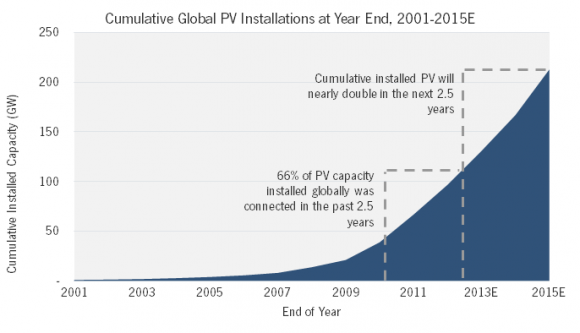
With the cost of solar dropping rapidly, installations are escalating at an exciting rate.
Earlier this year, the U.S. became the fourth country to have 10 GW of solar energy capacity, with installations increasing at a rate of 50 percent annually for the last five years. That rate is expected to increase to 80 percent this year.
⅔ of global solar capacity has been installed over the last two years. In contrast, 175 coal fired power plants in the U.S. are expected to be shut down over the next five years (over 10 percent of total capacity). This reflects the rising costs of coal and the implementation of stricter environmental regulations.
(Photo courtesy GTM Research)
4. Investment
While fossil fuels have been an omnipresent part of investment portfolios for decades, their reign may be coming to an end.
Recently a number of reports have shed light on an impending "carbon bubble". Fossil fuel companies are valued in the market based on their reserves of unburned fuel still in the ground. If international regulations are put in place to prevent atmospheric CO2 from rising above 450 ppm (the estimated cap to avoid irreversible climate change), much of the listed reserves couldn't be burned for fuel.
This means that many fossil fuel companies are overvalued as they potentially have huge unburnable reserves of fuel. British bank HSBC estimates that once stricter climate regulations are put in place, the value of fossil fuel companies may fall drastically. Already, the market cap of coal companies has dropped in value 75 percent over the last 5 years.
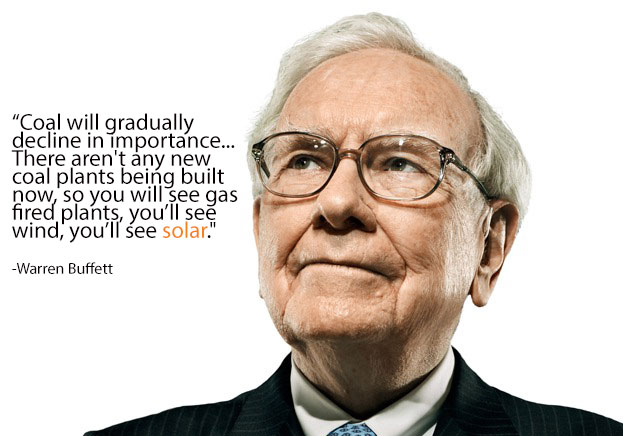
Firms like Mercer and WHEB are advising investors to move their investments out of coal and oil and into renewables. Major investors are already making this move. Warren Buffett has invested $5.4 billion invested in solar and has predicted the end of coal as an American power source.
New financing models like solar leases and PPAs allow more consumers to make the home-solar investment for little or no money down. Additionally, the company where I work,Mosaic, has created a new investment platform that enables you to directly invest in solar projects and earn steady returns.
5. Environmental Impact
This one should be pretty clear, but here are some interesting impacts of coal extraction and burning that you may not be aware of (sourcewatch, US EIA):
- Acid mine drainage and coal sludge pollutes rivers and streams.
- Air pollution which causes acid rain, smog, numerous respiratory illnesses and cancers, and toxins in the environment that are harmful to ecosystems.
- Coal dust from mining causes respiratory illness.
- Coal fires in abandoned mines put tons of mercury into the atmosphere every year and account for 3 percent of global carbon dioxide emissions.
- Coal combustion waste is the second largest contributor to land fills after solid waste
- Mountaintop removal for mining causes flooding, destruction of entire ecosystems, and release of greenhouse gases.
- Emission of 381,740,601 lbs of toxic air pollution annually.
- Emission of 3.3 trillion lbs of CO2 annually - an enormous contribution to global climate change.
(Photos courtesy ASU News)
Jacob Sandry is an Energy Studies scholar at Yale University and a fellow at Mosaic. He has worked in Colorado to protect endangered waterways and in Bolivia to protect animals rescued from the black market. Jacob has been to 5 continents, but originally hails from Minnesota where he developed his appreciation for the environment by camping, hiking and running. When not writing about clean energy, he's slam poet and an aspiring astronaut. Follow him on twitter @yaakovsandry.
Thursday, October 10, 2013
Friday, October 4, 2013
Greenport embraces solar, wind power
Members of the Greenport Town Board voted unanimously Wednesday to enter into agreements with companies offering solar and wind power for the town.
The board voted to enter into an agreement with Monolith Solar Associates LLC to install a photovoltaic system to provide solar energy for town hall. The solar panels will be installed on the ground on the property adjacent to the building, as opposed to the building itself, due to the orientation of the building not being conducive to solar panels.
Town Engineer Ray Jurkowski told those on hand there will be no cost to the town for that installation of equipment and that there will be an estimated 20 percent reduction in the rate that is charged to the town as far as supply.
The lease is for 20 years, and at the end of that lease the town can purchase the panels if it chooses to do so or choose to extend the lease for another five years. Or it could tell Monolith to remove the solar panels and end its relationship with the company, Jurkowski said.
The company is responsible for visiting the panels for maintenance once a year and remotely monitoring the panels to ensure they are working properly. The panels have a life expectancy of 20 years, according to the company.
“If the panels or any of the other equipment is damaged, it’s their responsibility to remove and replace it,” Jurkowski said. “It behooves them to make those repairs because they are gaining the most benefit as far as the sale of the electricity.”
Greenport Town Hall will be the trial location, with other locations in the town to follow if the test goes well, including the sewer and water pump stations.
The town also voted to start getting its power with Viridian Energy, a supplier of wind-generated power, to provide power for 16 electrical meters in the town, which the company estimates will save the town $80,000 a year. The town will retain National Grid as its utility company, which will distribute power and maintain the lines, but will no longer be its energy provider.
On hand for Wednesday’s meeting was Patrick Manning, a Virdian Energy associate, who gave a presentation to the board at the beginning of the meeting prior to the board vote.
“About 20 years ago, the federal government told the utilities that they can’t make energy and sell it to yourselves and then sell it to consumers, because that’s a monopoly,” Manning said. “We didn’t allow it for the cell phone companies and the phone companies and the Ma Bells, we shouldn’t be doing it with the electric companies.”
The supply side costs have since become competitive, and in New York municipalities are allowed to choose a provider as an alternative to letting the utility company use their default supplier, which Manning said can be much more expensive.
Friday, September 27, 2013
H&V Collision Centers Installs Solar Panels for Greener Energy
H&V Collision Centers, the largest independently owned collision repair facility in New York's Capital Region, is continuing its efforts to improve environmental efficiency by utilizing solar energy to help power its multiple locations.
The collision repair company is working with Monolith Solar to install solar panels at H&V locations in Troy, Colonie, Queensbury and Saratoga. Monolith specializes in design, sales and services of solar systems for business and residential customers. The panels installed by Monolith will convert sunlight into kilowatts to power the four H&V locations. H&V joins a growing trend of organizations, including schools, businesses, community organizations and agricultural businesses, utilizing solar power to become more environmentally friendly and reduce energy costs. “H&V Collision Centers places a priority on being a good neighbor and increasing our environmental efficiency," said Vartan Jerian Jr., H&V vice president. "The switch to solar continues those efforts and will allow H&V to rely on more environmentally friendly energy sources. We take pride in providing a high level of customer service and satisfaction, and are excited that commitment to quality will be powered by cleaner and more efficient sources of energy." In 2010, H&V became the first shop in New York to be recognized by the Coordinating Committee for Automotive Repair for efforts in promoting environmental efficiency and safety. To be certified as CCAR GreenLink shops, organizations must demonstrate high standards in environmental, health and safety operations in four categories, including business operations, employee training, safety compliance and environmental management. The utilization of solar power by H&V Collision Centers follows a switch by H&V to less toxic paints and processes. The switch involved a transition from solvent-based paints to waterborne paints at H&V. |

Subscribe to:
Posts (Atom)